Human Ingenuity—A Civilization Suspended by the Banks of the Qinhuai River
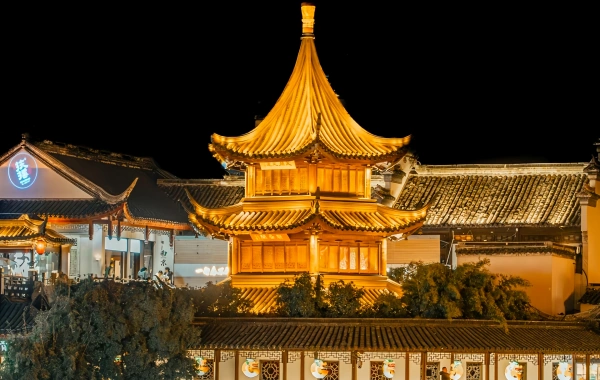
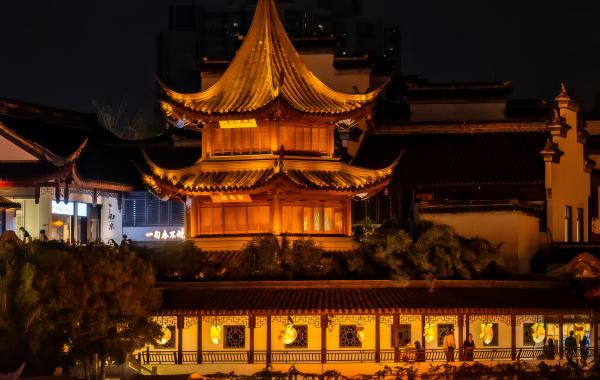
The architecture here is not merely an assemblage of bricks and timber;it is a frozen melody—a tangible embodiment of the misty romance of the Six Dynasties era and the refined elegance of the Ming and Qing dynasties.
1.The"Foremost Spirit Wall Under Heaven"and the Panchi Crescent Pond
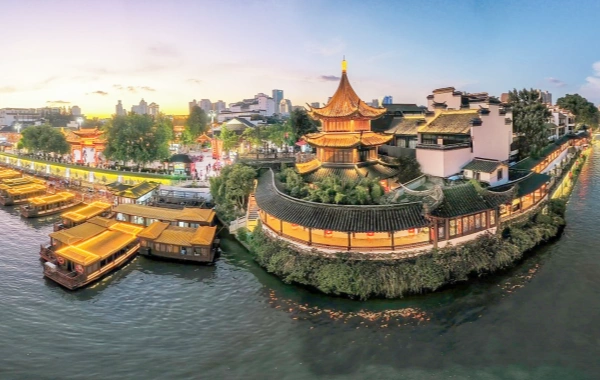
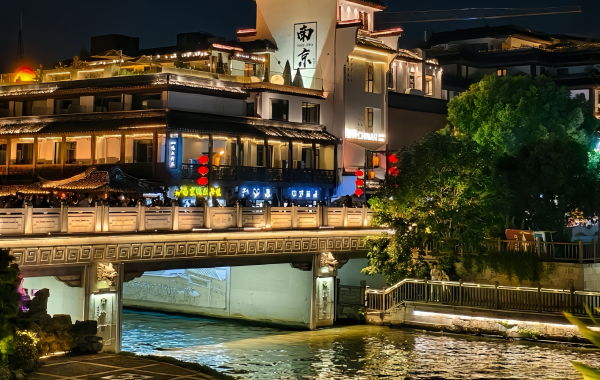
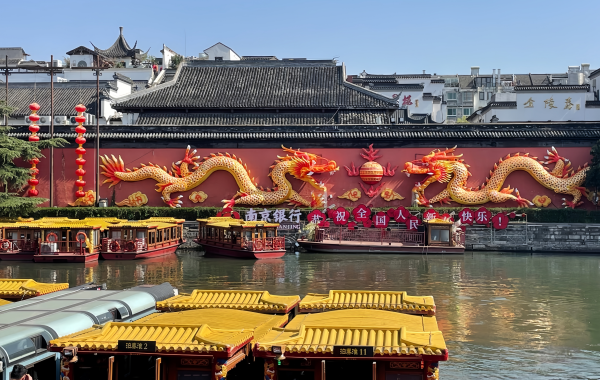
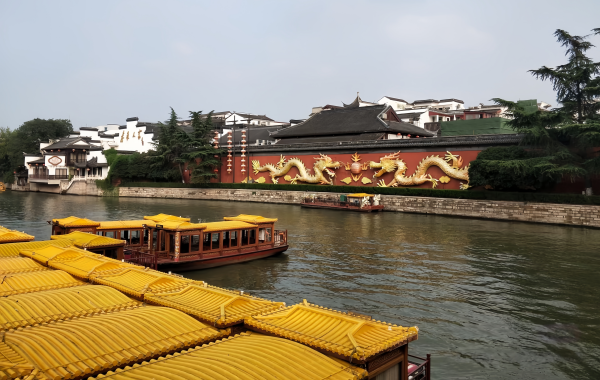
The Great Spirit Wall(Zhaobi)of the Confucius Temple is situated on the southern bank of the Qinhuai River.Constructed in the third year of the Wanli reign of the Ming Dynasty(1575),it measures 110 meters in length and 10 meters in height,making it the largest spirit wall in all of China.Beneath this wall lies the Panchi(Crescent Pond)—the only Panchi among all of China's Confucius Temples that is fed by a natural,living water source.The waters of the Qinhuai River flow ceaselessly through this pond,symbolizing the adage that"living water must have a source"—a metaphor for the continuous,vital flow of the literary and scholarly heritage nurtured at this"Nexus of Culture Under Heaven."
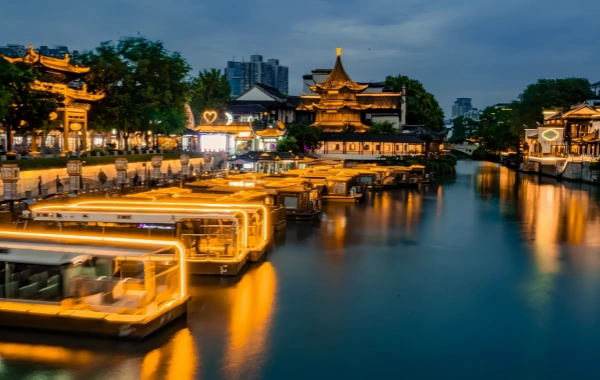
Photography Tip:Standing on Wende Bridge at dusk allows you to frame the Spirit Wall,the Crescent Pool,and the"Tianxia Wenshu"Archway all in a single shot;the scene is particularly stunning during the"blue hour"at twilight.
2.The"Tianxia Wenshu"Archway and Lingxing Gate
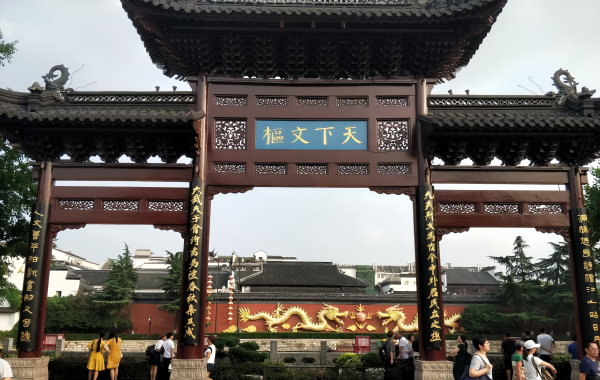
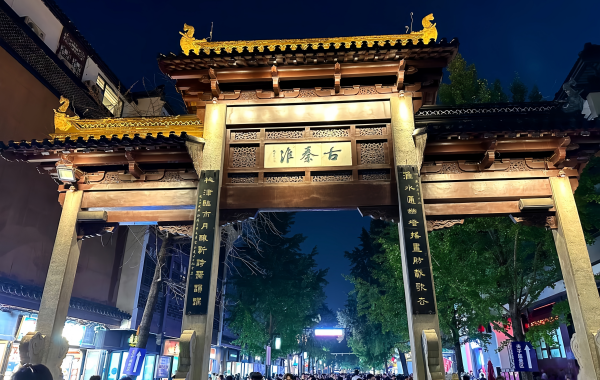
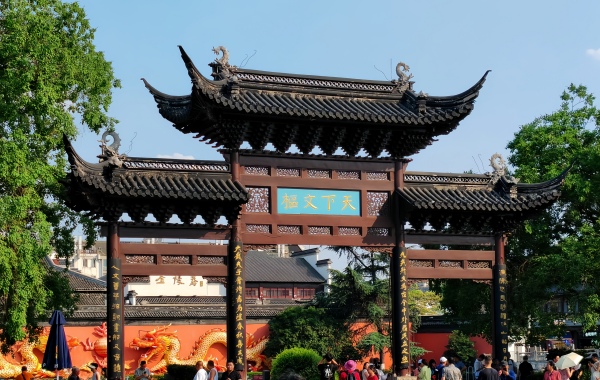
Located in the square in front of the temple,the cypress-wood"Tianxia Wenshu"(Literary Hub of the World)Archway is an iconic photo spot at the Confucius Temple,signifying Nanjing's historical status as a cultural epicenter.Behind the archway stands the Lingxing Gate—a stone archway featuring six pillars and three bays.The pillar capitals are carved with cloud motifs,resembling Huabiao(ornamental columns),and symbolize the reverence for the Sage as being as boundless as the heavens.Embedded between the three gateways are brick bas-reliefs depicting peonies,exuding an air of rustic elegance.
3.The Dacheng Hall—A Sacred Site for Sacrifices to Confucius
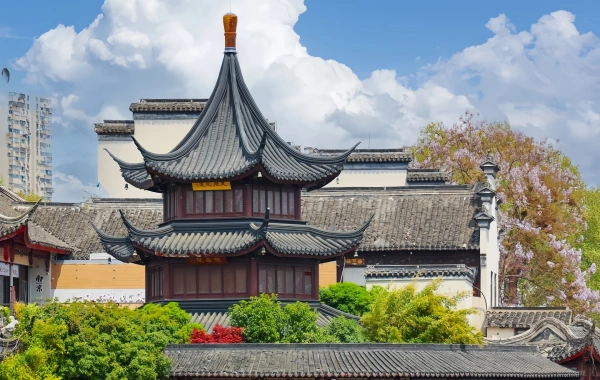
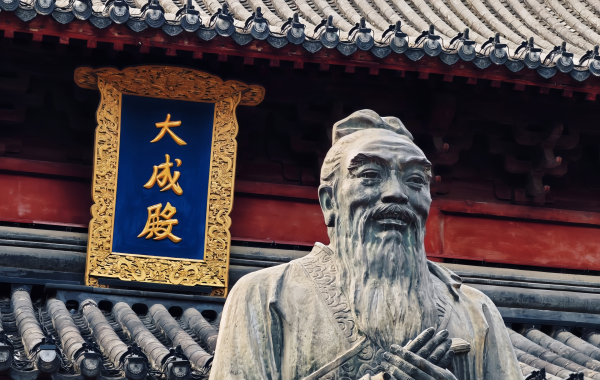
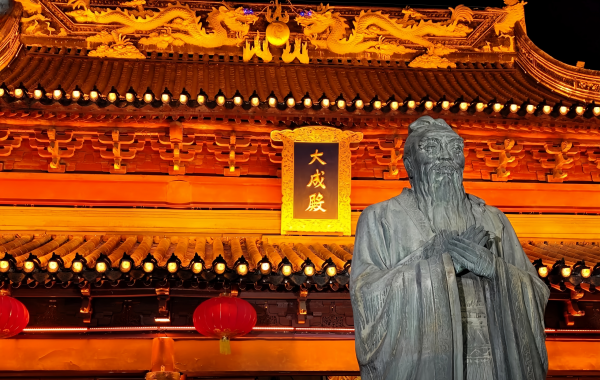
The Dacheng Hall serves as the central edifice of the Confucius Temple.Featuring a double-eaved Xieshan(hip-and-gable)roof,it stands 18 meters tall and spans seven bays,commanding a magnificent and imposing presence.Suspended in the center of the hall is the largest portrait of Confucius in China,measuring 6.5 meters in height and 3.15 meters in width;it is flanked by white marble statues of the Four Sages:Mencius,Zeng Shen,Yan Hui,and Kong Ji.The terrace outside the hall serves as the venue for the ritual dances and music performed during the spring and autumn sacrifices to Confucius;its four corners are fitted with red copper braziers that burn tung oil torches,illuminating the night as brightly as day.The hall also houses a treasured collection of four ancient steles,including the"Stele Depicting Confucius Inquiring About Rites."Carved during the second year of the Yongming reign of the Southern Qi Dynasty(over 1,500 years ago),this particular stele is revered as the"Guardian Treasure"of the Confucius Temple.
4.Mingde Hall and the Imperial Academy
Situated behind the Dacheng Hall,the Mingde Hall serves as the principal structure of the Imperial Academy(Xuegong).In ancient times,it functioned as the main auditorium where students gathered for classes;originally established during the Eastern Jin Dynasty,the current structure was reconstructed in the eighth year of the Tongzhi reign of the Qing Dynasty(1869).The plaque displayed in front of the hall,bearing the inscription"The Foremost Academy of the Southeast,"underscores the exalted status the Confucius Temple held within the ancient educational system.The corridors flanking the Imperial Academy house an exhibition of over 30 stone steles featuring calligraphy by renowned contemporary masters,creating a fascinating interplay between modern artistry and ancient heritage.
5.Jiangnan Examination Compound and the Imperial Examination Museum—The Cradle of Ancient Chinese Officials
The Jiangnan Examination Compound was the largest imperial examination venue in ancient China;at its zenith,it boasted 20,644 individual examination cells,capable of accommodating over 20,000 candidates simultaneously.During the Ming and Qing dynasties,more than half of the nation's Zhuangyuan(top scholars)emerged from this very site;luminaries such as Tang Bohu,Zheng Banqiao,Shi Naian,Wu Jingzi,and Chen Duxiu all passed through its gates.Today,the Imperial Examination Museum—the nation's only underground museum—stands upon the ruins of the original compound.Its 33 exhibition halls offer a comprehensive retrospective of the imperial examination system,from its origins to its evolution,while its collection of original examination papers from the Zhuangyuan Palace Exams is truly breathtaking.The Mingyuan Tower,serving as the compound's highest vantage point,and the Feihong Bridge—which historically marked the boundary between the"inner"and"outer"examination sections—are both must-visit historical landmarks.
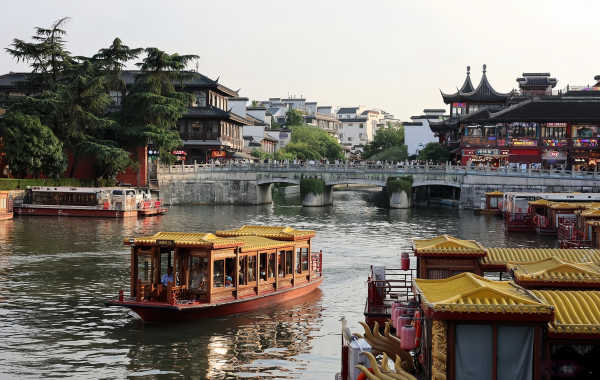
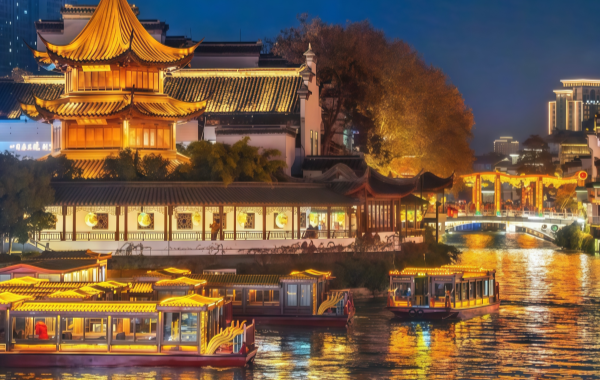
Photography Tips:The best vantage point for a panoramic shot is atop the Wende Bridge,where you can simultaneously capture the Spirit Wall,the Panchi(Crescent Pool),the"Tianxia Wenshu"Archway,and the painted pleasure boats of the Qinhuai River.
The top floor of the Deyuetai Pavilion offers an ideal angle for shooting aerial-style views of the Qinhuai River's S-curve and the rooftops of the ancient architectural complex.
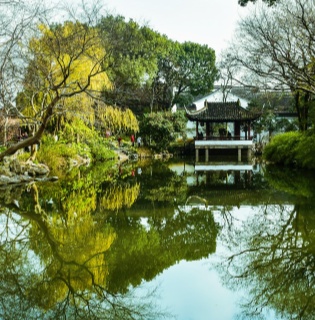
The"Water Stage"within the Imperial Examination Museum provides a stunning opportunity for symmetrical compositions by utilizing the water's reflection.
Drone flight is permitted in the area;however,please pay close attention to designated no-fly zone warnings.
6.Wuyi Lane—Where the Swallows of the Wang and Xie Clans Once Flew
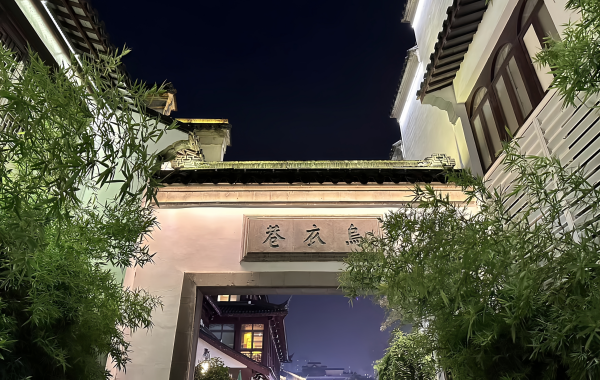
Crossing to the southern bank of the Wende Bridge brings you to Wuyi Lane.This ancient alleyway,approximately 350 meters in length,earned its name during the Eastern Wu period when the soldiers stationed here wore black military uniforms(wuyi).During the Eastern Jin dynasty,the Wang and Xie—two of the most prominent and influential aristocratic clans of the era—resided here,producing cultural giants such as Wang Xizhi,Wang Xianzhi,and Xie Lingyun.The immortal couplet by the Tang Dynasty poet Liu Yuxi—"Wild grasses and flowers bloom by the Zhuque Bridge;the setting sun slants over the entrance to Wuyi Lane"—has transformed this place into a pilgrimage site for scholars and literati throughout the ages.The lane still preserves historical relics such as the"Wuyi Well,"while the Wang Dao and Xie An Memorial Hall utilizes physical artifacts and scene reconstructions to vividly recreate the aristocratic grandeur of the Six Dynasties period.
Nature's Masterpiece—The Breath and Pulse of the Qinhuai River
Although the Confucius Temple area is renowned primarily for its cultural and historical landmarks,the natural beauty of the Qinhuai River itself is equally captivating.
The"Ten-Li Qinhuai"—The Mother River Amidst Oars and Lantern Glow
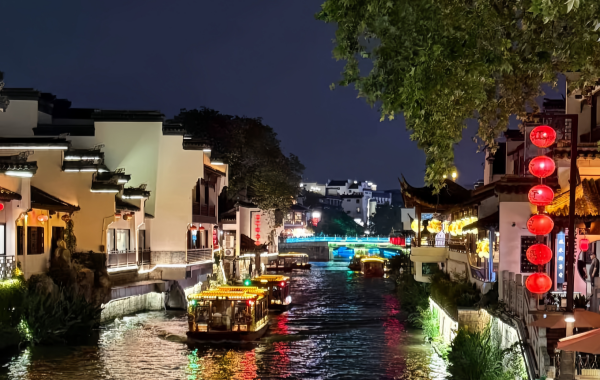
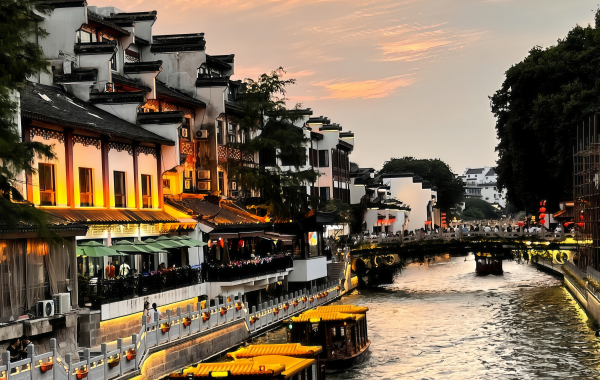
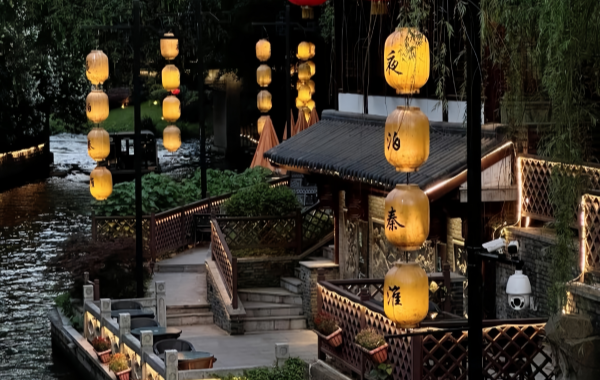
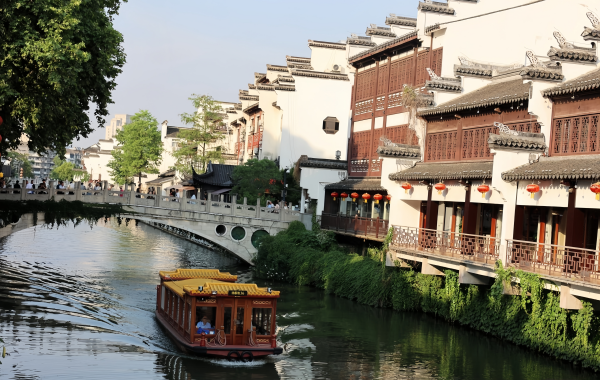
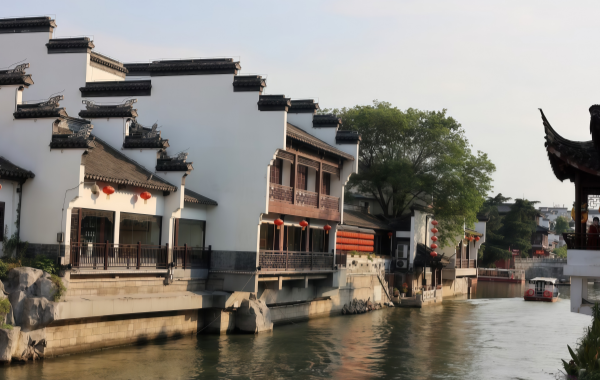
The Qinhuai River is Nanjing’s"Mother River."The Inner Qinhuai River—spanning 4.2 kilometers from the East Water Gate to the West Water Gate—is historically known as the"Ten-Li Qinhuai."Along its banks,whitewashed walls topped with dark-tiled roofs stand in contrast to ornate pleasure boats gliding across the ripples.The eponymous essay The Qinhuai River Amidst Oars and Lantern Glow—penned jointly by Zhu Ziqing and Yu Pingbo—has immortalized the beauty of this place within the annals of Chinese literature.The best way to experience this scenery is by taking a night cruise on a painted pleasure boat.The Eastern Route passes by Bailuzhou Park,Taoyedu Ferry,and the East Water Gate,offering a tapestry of historical sites,classical gardens,and bustling streets along the way.The Western Route,meanwhile,utilizes immersive light-and-shadow technology to bring the Southern Capital’s Grand Gathering scroll painting to life,creating the sensation that one is"sailing right through the artwork."
Qinhuai Lantern Art—A Feast of Intangible Cultural Heritage Rich in Lunar New Year Spirit
Every year,from the first to the eighteenth day of the Lunar New Year,the Confucius Temple(Fuzi Miao)hosts the Qinhuai Lantern Festival.This traditional folk custom—which originated during the Six Dynasties period and reached its zenith during the Ming Dynasty—boasts a history spanning over 1,700 years.During the festival,the Confucius Temple Plaza,the Dacheng Hall,the Jiangnan Examination Compound,and indeed the entire banks of the Qinhuai River are adorned with tens of thousands of lanterns,creating a dazzling spectacle.Lotus lanterns,Zodiac lanterns,"Ao Mountain"lanterns...these creations,meticulously handcrafted by lantern artisans,represent an irreplaceable symbol of the Lunar New Year spirit in the hearts of Nanjing’s people.Even outside of the festival season,the lantern market on Zhanyuan Road sells these lanterns year-round,offering visitors a unique souvenir to take home.
The Seasonal Beauty of the Qinhuai River
Spring(March–May):The weeping willows along the banks burst forth with fresh green foliage,while peach and apricot blossoms bloom in succession;a morning stroll along the river is a truly delightful experience.
Summer Nights(June–August):Shaded by lush trees and cooled by gentle evening breezes,this is the ideal season to experience the romance of"mooring for the night on the Qinhuai"—though visitors should be mindful of mosquitoes.
Autumn(September–November):The skies are high and crisp,the ginkgo trees turn a brilliant gold,and the ancient architecture appears even more rustic and elegant amidst the autumn colors.
Winter(December–February):Crowds are sparse during this season;should a snowfall occur,the contrast between the white walls,dark-tiled roofs,and vibrant red lanterns creates a scene as exquisite as a traditional ink-wash painting.